Vitamin D in Kenya

Kenya sits on the equator. Vitamin D insufficiency shouldn't be this common here.

Few countries on earth get more direct, overhead sun than Kenya. Yet hospital studies from Nairobi to Kenyatta National Hospital keep finding the same pattern: a meaningful share of people test low on vitamin D anyway.

Geography

A country built around the equator

Kenya is one of a handful of countries the equator physically runs through — splitting it almost exactly between the northern and southern hemispheres. That's not a figure of speech, it's latitude. Here's how close some of Kenya's biggest towns sit to it.

0.02° N
Nanyuki
The equator line itself runs through town
0.09° S
Kisumu
Lake Victoria region
0.30° S
Nakuru
Rift Valley
0.51° N
Eldoret
North Rift
1.29° S
Nairobi
The capital
4.04° S
Mombasa
The coast

The evidence

Three Kenyan studies. Same pattern.

Different hospitals, different groups of people, different years — each one found a meaningful share of Kenyans testing below sufficient vitamin D levels. Full studies are linked below if you'd like to read them yourself.

17.4%

Healthy blood donors, Nairobi

Deficient on testing — in people with no symptoms at all, living close to the equator.

Aga Khan University Hospital · 2018 Read study →
37%

Patients at a Nairobi clinic

Tested deficient at a family medicine specialist center in the city.

Nairobi, 2023 Read study →
~60%

Type 2 diabetes patients, KNH

Deficient or insufficient combined, with levels linked to blood sugar control.

Kenyatta National Hospital Read study →

The short version

Sunlight in the sky isn't the same as sunlight on your skin.

Your body only makes vitamin D when UVB rays hit bare skin directly. Kenya has no shortage of UVB — but daily life, geography and climate are all very good at getting between you and it.

What to look out for

Signs and symptoms worth noticing

Most people with low vitamin D feel nothing unusual at all — that's part of what makes it easy to miss. When symptoms do show up, they tend to be quiet and easy to blame on something else.

!

This is general information — not a diagnosis

None of the points below are a checklist to self-diagnose against. Fatigue, aches and low mood all have plenty of causes that have nothing to do with vitamin D. The only way to know what's actually going on with your levels is a blood test with your doctor — please don't use this page to draw conclusions about your own health.

01

Persistent fatigue

Tiredness that doesn't track with how much you slept.

02

Bone or lower back ache

A dull, ongoing ache rather than an injury.

03

Muscle weakness

Aching or weak muscles, sometimes cramping.

04

Getting sick more often

Catching colds or infections more than usual.

05

Low mood

Especially during long stretches of indoor, low-light days.

Higher likelihood, not certainty

Who tends to run lower

None of these guarantee low vitamin D, and none of them rule it out. They're the groups that established research consistently finds testing lower on average — worth knowing if you recognise yourself in more than one.

How to actually know

One blood test settles it

A 25-hydroxyvitamin D blood test measures your actual level in ng/mL. Ask your doctor or pharmacist about it — here's how the result is generally read:

Below 20 ng/mL

Deficient

Levels low enough to warrant attention and, usually, a conversation about supplementation.

21–29 ng/mL

Insufficient

Below the level most guidelines consider optimal — the zone a lot of tested Kenyans fall into.

Above 30 ng/mL

Sufficient

Generally considered an adequate level for bone and overall health.

These bands follow the Institute of Medicine (IOM) classification — the same reference ranges used in the 2018 Nairobi hospital study cited above (read it here). Your own doctor may interpret your result differently based on your history.

Getting more, naturally

Three ways to raise your levels

Supplementation is one option among a few — here's the fuller picture.

01 — Sun

Direct, unfiltered skin exposure

A short stretch of bare arms and legs in direct sun, a few times a week, is how your body makes vitamin D naturally. It has to be direct skin, not through glass.

A caution worth repeating: more sun is not automatically better. Overexposure still burns skin and raises long-term skin damage risk, regardless of how much vitamin D it makes. A brief, unburned exposure — a matter of minutes, not hours — is the goal. If your skin starts to redden, you've had enough; cover up or move to shade rather than "getting more D" for the day.
02 — Food

A short list of foods

Fatty fish, eggs and fortified foods carry some vitamin D — but diet alone rarely closes a real gap, since very few everyday foods contain much of it. A nutritionist can help you get the most out of what's actually on your plate.

03 — Supplementation

A measured, physician-guided dose

When sun exposure and diet aren't enough — common for people spending most daylight hours indoors — a supplement offers a reliable, controlled amount. It's worth raising with your doctor or pharmacist, who may point you toward something like Core D3.

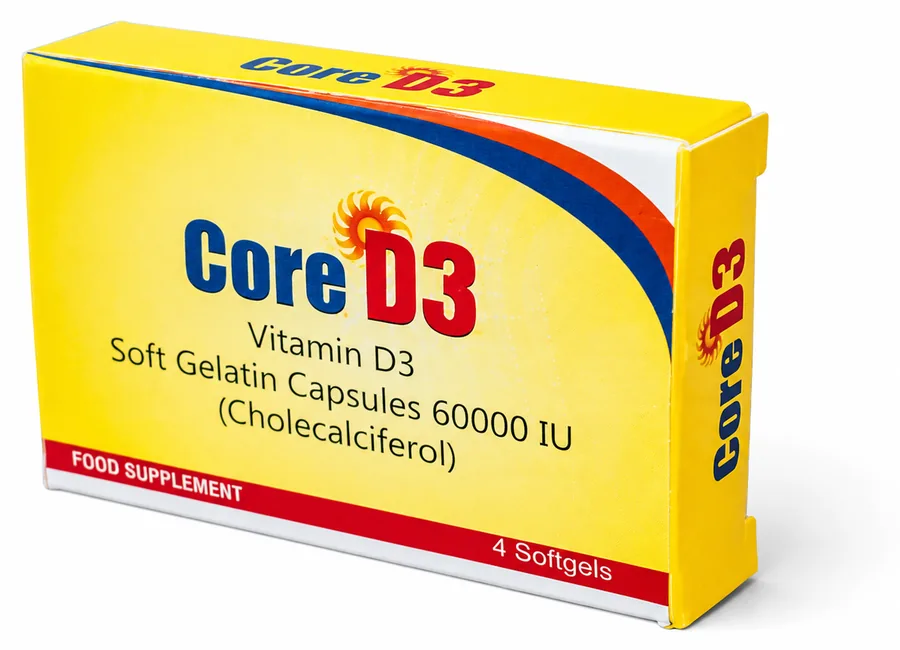
Core D3 Vitamin D3 Soft Gelatin Capsules 60,000 IU (Cholecalciferol) carton, front panel
THE CORE D3 RANGE

A high-strength softgel, built for the days sun doesn't reach you.

Each Core D3 soft gelatin capsule delivers a concentrated dose of Cholecalciferol — the same form of vitamin D your skin makes from direct sunlight — for the days spent mostly indoors.

  • Active ingredientCholecalciferol (Vitamin D3)
  • Strength60,000 IU per softgel
  • FormatSoft gelatin capsule
  • DosageAs directed by your physician

FAQ

Questions, answered plainly

What's the difference between "insufficient" and "deficient"?

They're two points on the same scale, both below what's considered optimal. Insufficient (21–29 ng/mL) is a milder shortfall than deficient (below 20 ng/mL) — both are worth discussing with a doctor, especially if a blood test flags either one.

Can I get enough vitamin D from Kenyan sunshine alone?

In theory, yes — Kenya's sun exposure is about as good as it gets. In practice, it depends on how much direct, unfiltered skin exposure you actually get on an average day, which for many people with indoor jobs is very little.

What is Cholecalciferol?

It's the scientific name for vitamin D3 — the exact form your skin produces when exposed to direct sunlight, and the form used in Core D3.

Can I take too much vitamin D3?

Yes. Vitamin D toxicity is rare, but it happens with prolonged high-dose supplementation taken without medical guidance — not from sun or food, since your body regulates both. Signs of taking too much can include nausea, vomiting, weakness, and excessive thirst or urination. It's part of why a high-strength dose like Core D3's 60,000 IU per softgel is meant to be taken as directed by a physician, rather than as a routine daily vitamin.

How do I know if Core D3 is right for me?

That's a conversation for you and your doctor or pharmacist — starting with whether you need a supplement at all, based on where your own blood test result actually sits.

Where can I find Core D3?

Through pharmacies across Kenya — ask your local pharmacist, or reach out to us directly below.

Get in touch

Make an enquiry

Have a question about Core D3, or want to know where to find it? Reach us directly or send a message below.

Not sure where your levels stand?

A simple blood test is the only way to know. From there, your pharmacist can tell you where Core D3 fits.